
After months of training, I decided the time was right to have my first professional fight in Thailand.
It wasn’t a tough decision at all; having the opportunity to train twice a day, six days a week, for a few months will get you into the best shape of your life, without a doubt.
Fighting in Thailand will be an enjoyable experience for someone from a Western country, and there are a few key points I wanted to note to help prepare others who are interested in coming out to train and fight.
Setting Up a Fight
Getting a fight scheduled for you is actually a straightforward task for your trainer or gym owner.
Every province has different venues to fight at, with varying skill requirements and levels of professionalism.
In Bangkok, you have the following options.
Asiatique: The Riverfront
Asiatique is a tourist-centric attraction located on the eastern bend of the Chao Phraya River.
You can call it an open-air mall; there are hundreds of connected shops selling various trinkets, clothing, souvenirs, and some great restaurants right next to the river. It’s a beautiful attraction, which is why thousands flock here every month.
In front of the mall, there’s a theatrical Muay Thai performance that happens every day except Monday called Muay Thai Live.
For one hour, guests can watch the history of Muay Thai in Thailand played out by actors, followed by two real Muay Thai bouts.
This is where entry-level Muay Thai fights occur. Your trainer will state the weight you want to fight at, but you won’t likely know your opponent’s weight until the day of the fight.
When I fought here, I didn’t even have to weigh in, which can be a good thing or a bad thing if you suddenly come up against an opponent who outweighs you significantly.
A fun experience, this is where you can gain experience and hone your skills in front of cheering tourists.
TV Promotions: Super Muay Thai, True4U, and MX Muay Extreme
Bangkok is the entertainment industry hub of Thailand, and you’ll find that there are a handful of Muay Thai promotions done by TV Studios.
Tickets are free for viewers, and you can expect to see some great fights from fighters of all skill levels.
Super Muay Thai is located near Rangsit, in the Workpoint TV Studio. Fights here are taken very seriously in comparison to Asiatique.
You must be within your stated weight class, or you won’t be able to fight.
True4U is another TV promotion in Rangsit that features fighters with a decent amount of experience.
They regularly hold tournaments with some large prizes that yield higher pay for fighters, and even the occasional car or truck.
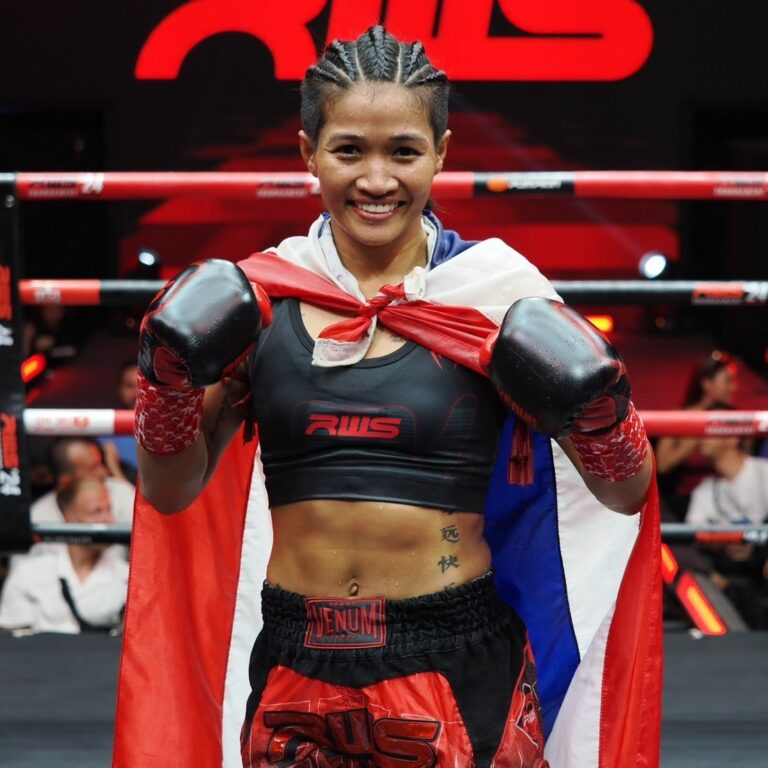
MX Muay Extreme is relatively new to the Muay Thai fight promotion scene; it’s been around since mid-2016 and features a slightly different set of rules from standard Muay Thai. Located in the GMM building on Asoke street, combatants wear 6oz, MMA-style gloves, which leads to more aggressive boxing and some incredible knockouts.
Skill level at Muay Extreme also varies significantly in the sense that you’ll have young Western fighters with less than ten fights be matched up against experienced, older Thai fighters with over a hundred fights.
The Stadiums of Bangkok
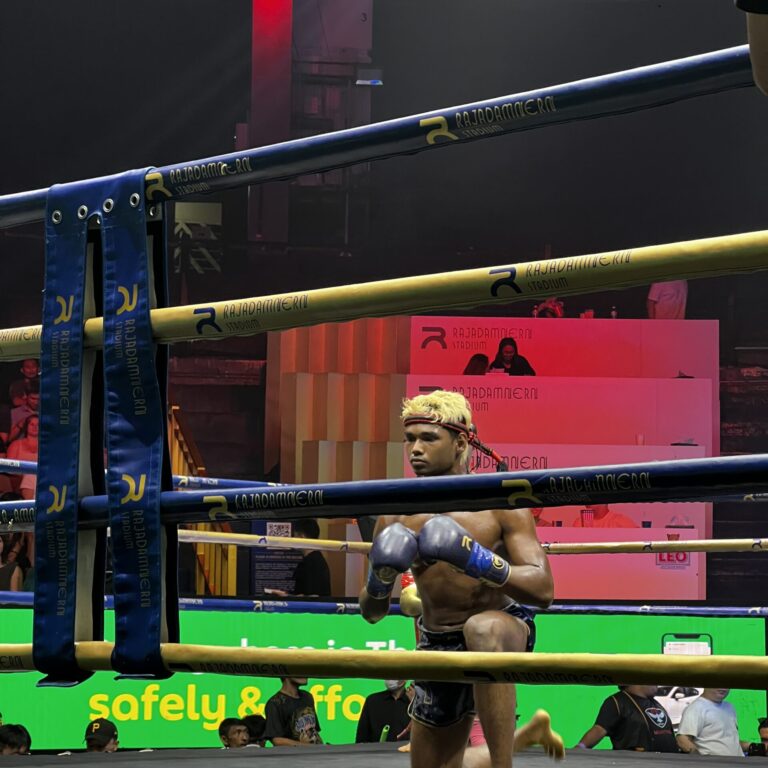
Lumpinee and Rajadamnern Stadiums.
Everyone interested in Muay Thai has heard of these legendary arenas. Your chances of fighting at these stadiums are very slim, as the majority of professional Thai fighters battle here. They are known as the two most prestigious places to fight Muay Thai, and it will take years of fighting to have the opportunity to fight in either stadium.
The Lumpinee and Rajadamnern belts can be considered the pinnacle of success in Muay Thai.
Many previous champions have gone on to start their own gyms in Thailand and abroad, as the pay fighters receive is 10 to 15 times that of other promotions.
Training for a Fight
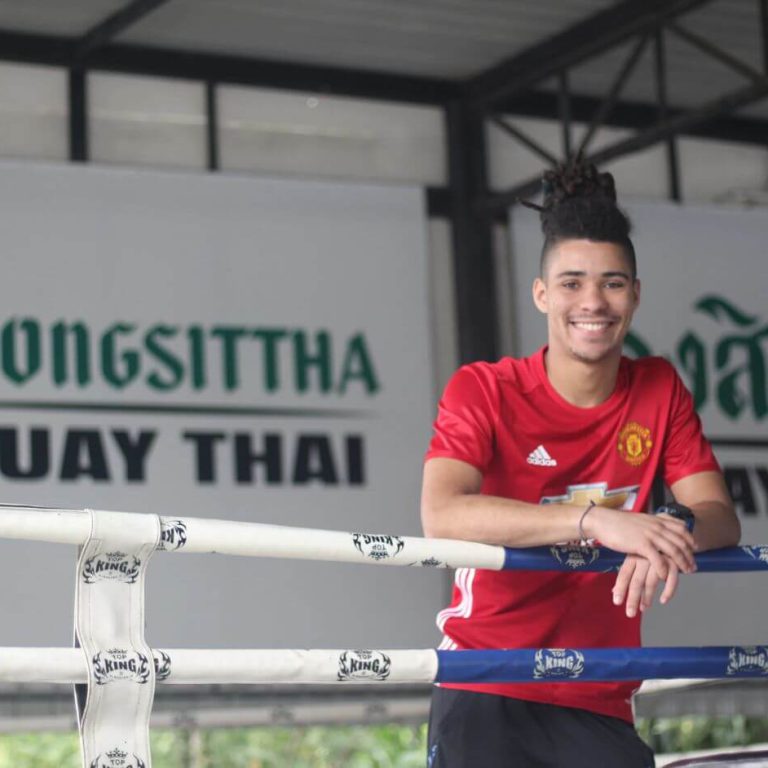
I had a grueling training routine set up to prepare for my fight, but every gym has its own way of preparing fighters.
In Thailand, gyms are commonly classified as either a “fighter’s gym” or “not a fighter’s gym.”
These labels are often misleading, as there are plenty of “non-fighter’s gyms” that produce quality fighters on a consistent basis.
Training at a fighter’s gym means that you’re surrounding yourself with dozens of other fighters who are actively fighting within the Muay Thai circuit of Thailand. These are professional athletes, training hard, twice a day, six days a week. They go through intensive training to simulate what it’s like in an actual fight.
Many western practitioners aren’t prepared for these vigorous schedules, and unless you’re planning on turning into a professional Muay Thai fighter, these gyms aren’t suited for you.
The “non-fighter’s gyms” usually only have a few fighters and are not looking to turn westerners into professional fighters. They rely on foreigners to come and train, and usually have just as good, if not better, trainers.
I personally feel that Muay Thai training and conditioning are what you make of them; it depends on how bad you want it and what you’re willing to do to accomplish it.
Of course, putting yourself in a harsh environment will force you to adapt to survive, but I’ve seen incredible fighters come from gyms that wouldn’t be considered as fighters’ gyms.
The Day of the Fight
Alright, it’s time. You’ve trained your face off and you’re ready to step into the ring and take off someone’s head.
Being that my fight was at Asiatique, I didn’t have to worry too much about cutting weight, which made things easier mentally for me.
This won’t be the case in the other promotions mentioned, so make sure to make weight. My trainer was very laissez-faire about the entire thing, which also helped me stay calm the day of my fight.
I did a very light training session in the morning, and was massaged with “namman muay,” which is ligament oil to loosen up all my muscles. I drove out to Asiatique and arrived about an hour before my flight. This is the chance you’ll get to see your opponent and size him up.
Again, the whole experience is surreal, and it’s important not to have an over-inflated sense of seriousness about the fight. Remember, these fights happen every day, and chances are your trainer has prepared various fighters hundreds of times over his career. Your trainer will likely be calm, collected, and ready to guide you through the bout.
Everyone’s first fight will be different, and a range of emotions will come out leading up to, during, and after.
For what it’s worth, I think everyone who trains Muay Thai longer than a few months in Thailand should test their mettle in a ring, to feel those emotions and the adrenaline of fighting for the entertainment of others.
Also, just for the record, I won my fight.